Saturday, June 27, 2009

New Arrivals! Unique Garden Statues Animal Style Solar Light

New arrivals! We just got more unique garden statues animal style solar lights in stock now!

Solar Turtle Holding Lights, and more...


Solar Bear with welcome sign


Stainless Steel Dragonfly Solar Light


Stainless Steel Butterfly Solar Light

solar turtle

Turtle Solar Light With Amber LED

solar turtle

Snail Solar Light With Amber LED


Time to get solar animals light to decorate your garden!

New Solar Color Changing Wind Chimes Arrival!

We just got new Solar Color Changing Wind Chimes in stock.
Enjoy the sound of wind and get lovely color changing light!
On Sale now for $19.99 Limited time only!

SOLAR COLOR-CHANGING Moon Face Star WIND CHIME


SOLAR COLOR-CHANGING Butterfly WIND CHIME


SOLAR COLOR-CHANGING Dolphin WIND CHIME


SOLAR COLOR-CHANGING HUMMINGBIRD WIND CHIME

New Ornaments Solar Animal Lights Arrived

New Solar Animal Lights arrived.

We have added 11 kind of solar dog lights, such as Dalmation Dog With Lantern Solar Light,    Pug Dog With Lantern Solar Light, and more here.


Solar Lights - Troubleshooting


Solar Lights - Troubleshooting


Having Problems with your Solar Lights?


Here is a check list to help you fix them. Don't forget - most solar lights have an on and off switch - its underneath the "head" - make certain it is Solar garden lights troubleshootingturned on- you can check if they work by going into a dark closet or just simply cover the solar cell- as long as they are charged up.


1. Loose batteries -All solar garden lights and solar outdoor lights have batteries. Some times the batteries come loose in shipping- and no contact is being made or they may have some condensation. This is real simple to fix.


To check this, hold the light upside down with the top of the light held firmly in the palm of one hand. With the other hand, hold the clear plastic cover that surrounds the bulb, push down firmly and twist to either left or right. This will allow the body of the light to separate from the top exposing the batteries. Be very careful not to damage the circuit board or wiring. (don't pull all the way apart or you will break the wiring)- You will see the batteries and you can take them out and wipe them clean etc.


If the batteries have become dislodged, simply push them firmly back into position and fit the light back together (wipe them clean first).


2. Batteries are not charged - as we warehouse all the solar lights, they might have been sitting in our warehouse for a while before getting to your place, so they might run out of batteries sometimes. Thus, please charge them with switch OFF for upto 48 hours to fully activate the rechargable batteries.


3. Corrosion in your Solar Lights - there have been some instances where dampness has caused corrosion on the battery terminals and/or the batteries. This can be fixed by removing the body of the light as per the instructions 1 above, remove the batteries from their holder, and clean terminals at each end of the battery holder with sand paper or carefully scrape with a small knife to remove any corrosion. Do the same to each end of the batteries. Reassemble the light.


4. Flat batteries or faulty solar panel - at times it is difficult to determine whether there is a problem with the rechargeable batteries not holding their charge or the solar charger not working. In Most cases its a battery problem. Again, remove the body of the light as per the instructions 1 above. To test batteries, replace one rechargeable with one normal AA/AAA battery and test light by covering the solar cell. Do the same with other rechargeable battery. If one test works and the other fails, one rechargeable battery has failed so contact us here, and we will send out a replacement battery. Please remember that you must only use rechargeable batteries in your solar garden lights- but you can test the lights with normal batteries in order to see if your rechargeable batteries are dead. The rechargeable batteries included with your light should last 1 1/2 to 2 years. And can be easily replaced with new rechargeable batteries- We have them but most hardware shops will have them also. Try and use latest models of rechargeable batteries. Your solar garden lights should last easily through 2-3 battery changes.


4. If these tests fail, the solar garden light will require servicing, so again contact us here and we will make arrangements to have the light returned for repair.

How Solar Lights Work


If ­you have a yard and have ever thought about lighting it at night, then you have probably heard about solar lights. They are no longer expensive as we have been working hard to get your great prices, and their advantage is that you don't have to run any wiring for them. As long as a location gets direct sunlight, you can put a light there in about 15 seconds.Solar stainless steel light


These lights are extremely interesting because they are almost like mini-satellites. They generate and store their own power during the day and then release it at night. This is just like a satellite that stores solar energy while it is on the sunny side of the planet and then uses that energy when it's on the dark side. In this article, you will learn exactly how it happens!


The Basics

A solar light consists of the following components:


  • A Solar Cell on top

  • AA or AAA rechargeable Ni-Cad battery

  • A small controller board

  • LED light source

  • A photoresistor to detect darkness


If you pop off the cover, you will find that all of the working components are mounted as a single unit. On the back side you see this:


Inside a solar light


Next, we'll take a closer look at some of these components.


Inside a Solar Light


You can see the battery, LED and controller board. If you cover the light sensor, the LED turns on, like this:


Inside a solar yard light turned on


Here are close-ups of the LED and the controller board:


LED and circuit board inside a solar yard light


LED and circuit board inside a solar yard light


On the other side of this module is a four-cell solar array, measuring 2 inches by 2 inches (5 cm x 5 cm), and the photoresistor:


Solar yard light solar array


Here is a closer view of the photoresistor:


Solar yard light photoresistor


Now let's see how the these solar lights work to light your yard at night.


Producing Light


If you have read the article How Solar Cells Work, you have a basic understanding of solar-cell technology. A solar light uses standard solar cells in a very straightforward application.


solar cells


A single solar cell produces a maximum of 0.45 volts and a varying amount of current depending on the size of the cell and the amount of light striking the surface. In a typical yard light, therefore, you need four cells wired in series (see How Batteries Work for a discussion on series wiring). In this solar light, the four cells will produce 1.8 volts and a maximum of about 100 milliamps in full, bright sunlight.


components of solar yard lights


The solar cells are wired directly to the battery through a diode (which prevents the battery's current from flowing back through the solar cell at night). The battery is a completely standard AA Nicad battery. A battery like this produces about 1.2 volts and can store a maximum of approximately 700 milliamp-hours. During the day, the battery charges, reaching maximum charge except on shorter winter days or days when there is heavy overcast.


At night, the solar cells stop producing power. The photoresistor turns on the LED. In the case of this light, the relay is replaced by two other transistors.


the solar yard light process


The controller board accepts power from the solar cell and battery, as well as input from the photoresistor. It has a three-transistor circuit that turns on the LED when the photoresistor indicates darkness.


The LED draws about 45 milliamps with the battery producing about 1.23 volts (0.055 watts). It produces about half of the light that a candle would. The Nicad battery, when fully charged, can operate the LED for about 15 hours.

Half of a candle's light is not very much, and if you have ever purchased one of these yard lights you know that it really is not enough to provide illumination. You use them more for marking a trail -- they are bright enough to see, but not really bright enough to illuminate the ground to any great degree.


The reason why these lights are so expensive right now is because of the solar cells and, to a lesser degree, the Nicad battery. Solar cells remain expensive because they are manufactured from silicon crystals in cleanroom conditions. They are much less expensive than they were 10 or 20 years ago, but still fairly pricey. As a result, solar lights usually cost $10 to $20 per light. However, we imported these directly from manufacture so that we are able to offer you great price for solar lights..


The solar light shown here uses a single LED. More expensive lights may offer a combination of an LED and a small halogen flashlight bulb. The LED is on all the time, and the light bulb turns on for a minute or two when a motion sensor detects movement.


Written by Marshall Brain. Refer from home.howstuffworks.com/solar-light1.htm

Solar Light Buying Guide


What is an LED?


Solar lights are equipped with LED's. An LED, or Light Emitting Diode, contains a chemical compound that gives off light when an electric current passes through it. They've been around for many years, but only recently has the technology advanced so that they can be made bright enough to actually use as an independent light source.


How much light does an LED produce?


LEDs put out a tremendous amount of light for their size and energy draw. They create almost no heat and use very little electricity. In general, an LED uses about 1/10th the power of an incandescent bulb and they are up to 90% more efficient than both fluorescent and neon bulbs of similar wattage. Best of all, an LED will last thousands of hours; some have been tested to over 50,000 hours (vs. a standard flashlight bulb that will only last a few hundred hours).


A common mistake is to compare wattage between LED units and their incandescent and fluorescent cousins - wattage is a function of power consumption, not brightness.


What are the advantages of Solar Lighting?


An advantage of buying solar lights is that LED bulbs will never burn out during the lifetime of the product. Low voltage incandescent and fluorescent systems will need bulb replacements often and add cost and inconvenience to the product.


LED Lighting Guide*
1-2 LEDs

(equivalent to a night light)
1-2 LEDs
3-5 LEDs

(equivalent to a desk light)
3-5 LEDs
6-8 LEDs

(equivalent to a porch light)
6-8 LEDs
9 LEDs and Up

(equivalent to a flash light)
9 LEDs and Up


*This is only to be used as a reference when comparing brightness of a solar light. Items pictured may vary in brightness depending on the wattage used.

Solar Light FAQs

How do solar lights store energy and how do they work?

Solar lighting is the safest and easiest kind of outdoor lighting to install. Each light fixture contains a scientifically designed solar collector panel that converts sunlight into electrical energy. This energy is stored in highly efficient rechargeable batteries, used to light the fixture at night.


What is the difference between solar lights and incandescent or fluorescent lights?

Solar lights are equipped with LED's. An LED is a semiconductor device that emits visible light when conducting current. Therefore, solar lamps give off a different type of light than incandescent and fluorescent lights. A common mistake is to compare wattage between LED units and their incandescent andIntegral Solar Flood Lightfluorescent cousins - wattage is a function of power consumption, not brightness.


The proper measuring stick for outdoor lighting comparisons is lumens or candle feet, which measures the brightness of the light. A typical LED will give off the equivalent of a 2 watt bulb. However, LED unit is more intense and has a different angle of dispersion, while incandescent light just glows all around.


Another advantage of buying solar lights is that LED bulbs will never burn out during the lifetime of the product. Low voltage incandescent and fluorescent systems need bulb replacements often and add cost and inconvenience to the product.


How long do solar lights stay on?

The length of time that the lights stay on is dependent on the amount of sunlight received during the day. Most solar lights stay lit for up to 10 or more hours with fully charged batteries.


What advantages do solar lights offer?

Solar lights require no wiring and are very easy to install. And because they run on the sun's energy, they cost nothing to operate. That means they also are environmentally friendly, and helps us conserve our fast-depleting regular energy resources.


Are solar lights as bright as regular lights?

Solar lights are usually not as bright as other forms of outdoor landscape lighting. Thus, instead of harsh, glaring light, you'll have the benefit of softer, more subtle accent lighting that makes your outdoors look stunning in the dark.


What sort of maintenance will I need to be concerned with?

There is virtually no maintenance required except for occasional cleaning of the panel surface to keep it free of dust and dirt, regular battery checks, and replacing the batteries when required.


How often do the batteries need replacing?

The batteries are designed to withstand a minimum of 1000 deep discharges which is at least 1000 nights of light. They are readily available and easy to replace, rechargeable batteries.


How often will I need to replace the L.E.D. in my solar fixture?

The LED's themselves are not replaceable. However, their life expectancy typically exceeds 25 years, based on running 10 hours every night. Thus, LED bulbs will never burn out during the lifetime of the product.

Solar Landscape Lights


Ecologically and economically sound, solar landscape lights are popular fixtures to enhance the exterior of your home. Besides adding beauty, solar landscape lights offer safety.

Types of Lights

For your outdoor designs, landscape solar lights come in a variety of styles in two major categories.


Chalice Solar Path Light - 4 Pack

Stake-type lights: These lights rest on a sturdy stake. Shove them into the ground and they're ready to go at sunset. Typically, these solar landscape lights offer diffused light, which means the light spills out in every direction. Great for sidewalks, driveways, and anywhere people might walk.


Hanging lights: The pole is set in the ground as a stake, but these landscape solar lights rise to any level you wish. Use them to light up interesting features such as birdhouses or mailboxes.


Interesting Variations

Decorative lighting accents come in any form imaginable, and landscape solar lights are no exception. For example, globe landscape lights are luminescent spheres that give a playful accent to your yard. Or keep your lawn flat with recessed landscape solar lights. Stake them down and the lights are even with the ground.


Specialty landscape solar lights are also available. Picture a little solar lighthouse by your garden pond. Or holiday themed lights such as snowmen or an Easter Bunny! If practical is more your style, consider specialty lights such as your address or hidden walkway lights.


No matter your style, landscape solar lights deliver creative solutions that won't show up on your electric bill.

Solar Garden Lights

Your garden looks great in the day, but at night it's absolutely stunning. Solar garden and yard lights capture the sun and keep important yard accents lit around the clock.

Easy to set up

Solar yard lights stake easily into ground. Throughout the day, small solar panels collect energy from the sun and store it in a miniature rechargeable battery. At night, a solar garden light uses this energy to illuminate your yard.


It's all in the style

There are a few different types of solar garden and yard lights available for your use. Hook Solar Light Package


  • Spot Lights: These solar garden lights are great for highlighting a signature statue or other fixture of your garden. Use them to light your home's exterior as well.

  • Path Lights: Keep your walkways clear with solar yard lights along the edges.

  • Lanterns: Hang your lights up a bit with gorgeous lanterns. These solar yard lights look beautiful in gardens as well.

  • Specialty Lights: Solar garden and yard lights come in many forms. Imagine a glowing squirrel in your garden, or a decorative lighthouse by your pond.


Care-free maintenance

Solar garden and yard lights are ruggedly built to withstand the extreme weather of every season. Wet, cold, hot, or humid climates pass by a solar garden light with no worries. Occasionally dust off the panel and adjust its angle to maintain optimum working conditions for your solar garden light.

Solar Lights Versatility

Outdoor lighting provides safety and security to your home. A well-designed lighting plan can also make a dramatic change to your landscape - without a dramatic change to your budget.


Mushroom Solar Light Kit You should plan your solar landscape lighting based on several factors. First, select a focal point or main element around which to build your lighting plan. Elements to consider are large trees, the main entrance, a front walk or a specially-landscaped portion of your yard. Look for dark spots in corners and behind large bushes, and for potentially hazardous steps and curbs. Light these areas for safety and security. In high-maintenance areas, be sure to select the proper lighting, otherwise lawnmowers, power trimmers and other equipment can destroy your lights.


Your decision to buy a solar light should be based on your specific outdoor lighting requirements and the lighting effect you wish to achieve. The following points should be kept in mind while buying outdoor solar lights.


Number of Lights Needed

The number of lights used and the distance placed between them greatly changes the overall lighting effect. Generally, it is better to use fewer lights, placed closer together, (approximately within 10 feet of each other) than to use many lights, scattered too far apart.


Finishes

Choose verdigris and black for fixtures that you want to blend in with surrounding foliage. For fixtures with higher visibility, choose styles and colors that best complement your home's exterior design and landscape theme.


Types of Solar Landscape Lights

To make choosing a little simpler, first ask yourself which type of light will be best for your outdoor setting.


  • Tier lights direct light downward on the ground or shrubs and minimize glare, making them ideal for lighting walks and steps.

  • Floodlights are a good choice for eliminating dark areas around windows and doors.

  • Spotlights and floodlights direct light upwards at controllable angles to illuminate statuary and highlight landscaping fences and architectural surfaces.

  • Well lights throw light up and out to highlight a garden structure or wall.

  • Low fixtures contain the light close to the ground, perfect for landscape borders and driveways.

  • Taller fixtures spread the light over larger areas and can be used in gardens, patios or walkways.


Lighting Effects

Here are some outdoor lighting effects that'll help you choose your perfect solar outdoor lighting.


  • Down-lighting: Lights are mounted high up in a tree or arbor and aimed downward for a soft and romantic feeling. You can use spotlights, floodlights and spreadlights/pathlights to get this effect.

  • Up-lighting: Up-lighting uses fixtures that are surface or ground mounted and angled upward to highlight a key object. Use spotlights, floodlights, or in-ground fixtures for this effect.

  • Cross-lighting: Lights are mounted on either side of a tree, gate or arbor to reveal detail and soften shadows. Use spotlights or floodlights for cross-lighting effect.

  • Shadowing: A light is placed at ground level to throw an object's shadow on a surface behind it. Use spotlights, floodlights or in-ground fixtures for shadowing.

  • Silhouetting: Silhouetting lights the surface behind an object for a striking effect. Spotlights, floodlights, or in-ground fixtures are good for silhouetting.

  • Accent Lighting: Intense light is focused on a specific object to contrast it against a dark background. You can use spotlights or mini spreadlights for accent lighting.

  • Spread Lighting: Use spreadlights to create circular patterns of light to illuminate flowers and low shrubs from above.

  • Grazing Light: Using a beam of light which just grazes the surface of an object to reveal its texture. Using spotlights, floodlights or in-ground fixtures achieves this effect. For further enhancement, you might consider adding more color to your solar outdoor lighting. Solar lights are available in red, green, blue and amber for creating just the right outdoor atmosphere. Consider using one color scheme, such as blue, for a cooling effect, and amber for warmth. A mixture of colors adds drama to your solar landscape lighting.


With little effort, you can use the right solar outdoor lighting to bring out the colors and shadows of foliage and the many textures your landscaping has to offer.

Free Tax Month!

CA sales tax rate has increased, but why still paying taxes? Starting today, www.esolarlighting.com will pay all sales taxes for orders shipped within California until 6/30/09. (As before, we do not charge sales taxes for out-states.) 

Jump in today to make your garden a GREEN ever place with our solar powered products and enjoy free taxes!!


Click here to start!


New Item Arrival Butterflies with 5 Blinking LEDs Solar Light

Want something special for your garden? Here you go.
We have this new Butterflies with 5 Blinking LEDs Solar Light. See picture below:


Click here to buy for only $22.99 with free shipping.


4 Reasons to Get LED Solar Powered Lights

We are proud to provide you all kinds of LED solar powered lights at www.esolarlighting.com

Home LED solar powered lights are the latest in solar power products to hit the market. By being free of relying on traditional electricity sources, these modern lights are a dream for designers when it comes to outdoor lighting.

How solar power LED lights came about:

Ever since solar power became portable, people have thought of as many solar power uses as possible. What made solar power so attractive for outdoor lighting was its portability - replacing the need for long, unsightly extension leads in the garden. Initially individuals tried using compact fluorescent light (CFL) bulbs, but the small solar panels could not produce enough wattage for the lights to burn bright enough.

As a result the solar light market was limited to places near the equator with large amounts of sunlight. And even then the solar panels and batteries had to be large enough to cater for the period of longest nights, shortest days and cloudiest conditions.

Then as LED lights started hitting the market, manufacturers realized they would be ideal for solar lighting since they burned brightly, but used minimal power. And thanks to technological improvements in home solar power LED lights, the solar lighting market is no longer confined to equatorial areas with the most amount of direct sunlight and highest temperatures.

So what were the technological improvements, and how did they benefit the solar market?

They were:

1. Optimized system efficiency

LED lights are now capable of optimizing current flows, where no power is wasted, so the overall system efficiency is almost 100 percent.

2. LED's can be fine tuned

Since solar LED lights can be programmed, users are now able to select not only where the light is delivered but also how brightly and when it is delivered. This has led to a reduction in solar panel and battery size by as much as 50 percent of the original outdoor lighting system.

3. Effective illumination

LED lights are able to provide directional beams of light, where about 90 percent can be used for ambient lighting and a further 70 percent for task lighting. Furthermore, a 45 lumen LED light can create the same amount of light as a 75 lumen CFL bulb, resulting in lower electricity usage and costs for running a home power solar lighting system.

4. Improved performance, efficiency and lifespan in cold temperatures


Most outdoor lamps tend to lose performance and lifetime in colder temperatures - where they seem rather dim or burn out very quickly in sub-zero climates. But LED's are different - they don't produce light from a filament, but rather a micro-chip. And since micro-chips run better at lower temperatures, solar LED lights can last 5 to 10 times longer than CFL bulbs.

With all these technological breakthroughs anyone is now able to enjoy home LED solar powered lights at home, no matter where they live. And if you know how to make your own solar panel system, all you have to do is add some inexpensive LED lights to enjoy free outdoor lighting. It couldn't be simpler!

Article Source: http://EzineArticles.com/?expert=Tim_McDonald


Why do solar lights use LED as lighting source?


Why do solar lights use LED as lighting source?


All our solar lights use LED as lighting source. Please check www.esolarlighting.com to see our items.


What is an LED?


LED
is the common abbreviation for a light-emitting diode. Each individual
LED consists of a semiconductor diode that emits light when a voltage
is applied to it. Unlike incandescent or fluorescent lamps, which
create light with filaments and gases encased in a glass bulb, an LED
is a semiconductor device, which emits visible light when an electric
current passes through it.


 Advantages:


  • Durability and long life
    — LEDS in lighting fixtures can provide over 100,000 hours in solar
    applications. In comparison, an incandescent light bulb lasts
    approximately 1,000 hours.
  • Energy and maintenance savings — can be powered by a solar array and require little maintenance because of their long life.
  • Better quality of light - provide more than twice the luminous efficacy (lumens per watt) of incandescent lighting.
  • Safer — LED systems are low voltage and are generally cool to the touch (energy is delivered in the visible spectrum).
  • Smaller flexible light fixtures — resistant to vibration and shock and because of their size LEDS are useful for lighting small spaces.
  • Durable — LEDS have no filament to break and can withstand vibrations.
  • Environmentally friendly – LEDS do not contain mercury unlike florescent and mercury vapor lighting, which is considered hazardous to the environment.


  • Not all LEDS are the same


    LEDS come in many form factors.  These affect their operation.


    LEDs promise to transform the way we light the world


    That
    promise is found in LED’s ability to save energy, reduce maintenance
    costs, and change the way we look at our entire lighting infrastructure.  LED system performance depends not only on the performance of individual components, but also on how they interact.  Poor
    integration can lead to premature failure of LED-based lighting
    systems. Sol LED systems optimize integrated system performance, which
    means our LED systems will live up to their promise of long life,
    energy savings and reduced maintenance.


    Sol is at the forefront of the LED revolution for street lighting


    Using
    our extensive experience in solar lighting, our engineers have
    developed a family of LED products, which are specifically designed to
    capture the power and efficiency of this advanced solid-state
    technology.


    Delivering Performance and Dependability


    The
    unique characteristics of LED performance have been addressed with
    specific heat dissipation features. Because LEDS last longer, the labor
    and expense of multiple lamp changes is reduced.  Maintenance costs are lower and this provides reduced total cost of ownership.


    LEDS
    are solid-state devices which contain no mercury and last five times
    longer than metal halides – helping to reduce environmental waste. 


    Lumens per watt has long been the standard for measuring the efficiency of lighting fixtures.  Sol’s latest Quad Series delivers the most lumens per watt of any LED configuration.  Since 1990, Sol has had a solid reputation of providing reliable solar lighting products.  Our engineers are experts at maximizing light output.


    What makes LEDS so great?


    • LED lighting is increasingly used in a variety of lighting applications because it offers many benefits, including:
      LonLong Life
            

    • Highly Efficient

    • Energy Savings  

    • No warm up time

    • Better quality of light output

    • No hazardous disposal – unlike CF, CCFL, LPS and HPS which contain mercury

    • Intrinsically safe

    • Durable LED
      lighting systems have already proved to be very effective in indicator
      applications where brightness, visibility, and long-life are important.  Outdoor lighting applications such as street lighting, parking lot lighting,  and security lighting can benefit as well. 


    What is the life of an LED?


    LEDS generally do not fail by burning out but slowly reduce light output over time.  As solid-state devices, they will continue to operate even after 100,000 hours (solar applications).  Comparisons
    of lumen maintenance near the end of the rated life for traditional
    light sources (i.e., incandescent, fluorescent, HID) have shown that
    with the exception of metal halide lamps, these traditional light
    sources usually have at least 80% of their initial light output by the
    time they have operated 10,000 hours.  Furthermore, when
    light level reductions occur over time, people tend not to notice them
    until the light level reaches 80% of the initial output.  This is the basis for “useful life” for lighting sources.


    What is an LED lighting system?


    As
    with other light source technologies, such as fluorescent, CCFL and
    HID, lighting systems using LEDS can be thought of as having a light
    source (typically the combination of LEDS that form the light source
    itself), a ballast (for LEDS it is often called a driver), and a
    luminaire (the fixture). 


    LEDS require a specific electrical polarity.  Applying voltage in reverse polarity can destroy them.  A slight change in voltage can result in very large changes in current.  Since the light output of an LED is proportional to its current, LEDS can be driven at various light outputs.  If
    the resulting current exceeds limits recommended by the specific LED
    manufacturer, the long term performance of the LED can be affected
    resulting in shorter useful life.  This means that many LEDS can produce a high light output, but have a very short life.


    An LED driver performs a function similar to a ballast for discharge lamps.  It controls the current flowing through the LED.  Most LED drivers are designed to provide current to a specific device or array.  It is very important that a driver be matched to the specific device.


    LED systems are rated in terms of luminous intensity in candelas (foot-candles) rather than light output in terms of lumens.  Luminous
    intensity is a function of the angle from which an LED is seen, so this
    value should be considered carefully when used to characterize light
    output of a particular LED source.  Two LEDS with the same
    luminous flux output can have very different peak luminous intensities,
    if they are designed to produce different beam angles. 


    Copyrights by www.solarlighting.com (See: www.solarlighting.com/?p0=1&p1=13&p2=15)

    Stainless Steel Solar Color Changing Lights Night Perfomance

    I recorded the night performance of one of our most popular solar lights: Stainless Steel Solar Color Changing Lights
    It changes color automatically from one to three seconds.


    Click Here to purchase.

    Saturday, April 4, 2009

    DIY solar-powered fountain

    Photo


    Here is the perfect solution to upgrade your garden water fountain into Solar-Powered Fountain.

    The elements shown above are: fountain + solar panel with water pump = Solar Powered Fountain

    Fountain
    : The fountains come from places like OSH. In the past, I thought it tacky that most of the fountains I've seen say "pump not included" on the price tag. But now I think that's perfect because I don't want a pump that plugs into the power grid, but one that plugs into the sun, via a solar panel.

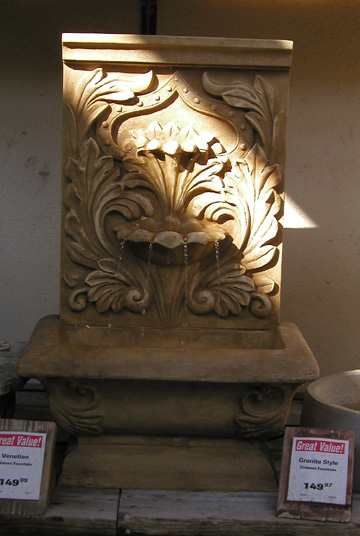
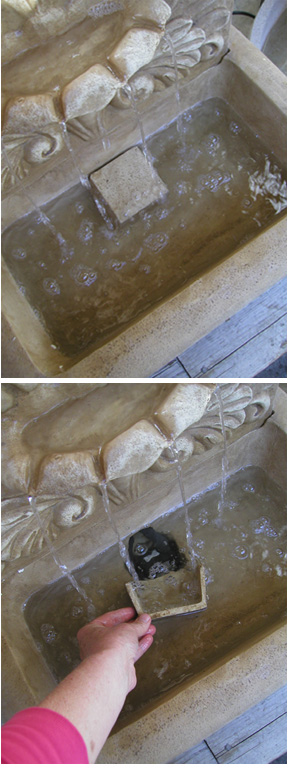
    This faux-stone fountain (see larger view), which is about 3 feet high, costs about $150. The pump fits inside the bottom basin and the water is pumped via a tube behind the fountain and up to the top. See that here. I found fountains at OSH and other stores for $50 and up. The key for me is to find a fountain with shallow places where birds can bathe and frolic. One deep well or bowl, for instance, will not work. This fountain has two shallow lips where water gathers and then spills over. The bottom bowl is a bit deeper and I might put rocks in there to create more places to perch. I realize that inviting birds to a fountain cause problems with droppings and feathers that can clog the pump. But that's a price I will pay.

    Pump and solar panel: The one pictured is a solar powered panel with water pump system costs $44.99 including a battery that charges up to run the fountain when the sun goes down. This setup pumps 47.5 gallons per hour, with a maximum lift of 20 inches. If the distance between where the pump sits and where you want the water to come out is more than that, you have to get a larger pump here. My fountain is unique in that the pump sits up high underneath the second tier and the water gets lifted only about 8 inches to the top tier, where it can spill over. See it here.

    Referred from: Kathy's Remodeling Blog

    http://latimesblogs.latimes.com/pardonourdust/2008/03/do-it-yourself.html

    Benefits of Solar Powered Lights

    Green (Environmental): Solar energy is about as natural a source of energy as you can get. Energy from Solar Panel is sustainable and renewable, unlike our current major sources of energy. » It does not contribute to global warming, as it does not contaminate the air by releasing carbon dioxide or other pollutants. » The use of solar energy for homes and businesses can help reduce transport of fuel that would otherwise be used for heating, further reducing carbon emissions.

    Green = Money: Your electric bill can drastically decrease, or disappear all together » Lighting up your yard without any concerns. The shining light will warm your house any time.

    Self-Sufficient / Low Maintenance eliminates worry in the event of a power outage. No more losing hundreds of dollars in groceries (I've experienced this one before...). » Solar energy systems don't require a connection to any grids, so they can be installed in remote locations. This can bring electricity to areas that otherwise would not have seen it. » The use of solar energy means lowering our dependence on foreign energy sources. » Once installed, solar panels require little to no maintenance and have no recurring costs.

    Tip: Solar panels are made of silicon. When they are hit by sunlight, the electrons of the silicon flow through wires that are built into the panels, which create the electricity. The earth receives more energy from the sun in one hour than the population of the world uses in an entire year, so solar energy, although initially expensive, is a viable option for a sustainable and renewable energy source.

    See Our Featured Products at esolarlighting.com that will bring all the benefits to you:


    solar ball


    The Color Changing Garden Clear Plastic Floating Ball Solar Light has the following features:

    • Solar powered No Wiring Powered by the sun
    • Fast and easy to install Energy saving Recharged by solar panels under sunlight
    • Light turns on automatically when dark Super bright LED for brighter light output
    • Rechargeable Ni-Cd AA battery (included)
    • Safe water resistant CE certified LED bulb never burns out Up to 10 hours of light when dark
    • Corrosion resistant LEDs can last up to 100,000 hours
    • Batteries are rechargeable and should last for approximately 2 years before replacing
    • Ideal for areas where conventional electricalsupply is not available
    • Item Size: 4’" x 4" x 4"
    • Color Changes Automatically
    • Click Here to Buy


    Monday, March 30, 2009

    8 Watt Solar Fountain Will be in Stock Soon

    Our two popular 8 watt solar fountains:
    Regular Version:


    and Battery with Timer version:


    will be in stock after 4/15/09 at esolarlighting.com

    Sunday, March 29, 2009

    esolarlighting.com formally launched

    eSolarLighting.com formally launched today on 3/29/09.

    eSolarLighting.com offers a large selection of solar powered lights and solar fountains. Go green! Get environmental friendly solar powered items at esolarlighting.com.


    Here are some hot items we are offering now:


    Solar Fountain


    2.6 Watt Solar Fountain With Battery System for $44.99 Only


    Solar Fountain


    Solar Landscape Lights - 8 Pack for $24.99 Only!